Boreal
LOVE, SEX & 2 1/2 SUICIDES
An Assisted Death
(Formatted for the web)
 Her respirologist could not confirm that her deteriorating lung condition
was due to a resurgence of her bacterial infection that drugs could no
longer contain or a return of the cancer without, in her weakened condition,
life-threatening biopsies. Over the sound of someone jack-hammering away he
explained that, whatever it was, there was nothing more they could do and
perhaps it was time for Lucette to consider entering palliative care.
Her respirologist could not confirm that her deteriorating lung condition
was due to a resurgence of her bacterial infection that drugs could no
longer contain or a return of the cancer without, in her weakened condition,
life-threatening biopsies. Over the sound of someone jack-hammering away he
explained that, whatever it was, there was nothing more they could do and
perhaps it was time for Lucette to consider entering palliative care.
With only a lung transplant able to save her life, we spent an afternoon in Montréal at a hospital where surgeons had performed a lung transplant on a person Lucette’s age. The surgeon we talked with was receptive to putting her on a waiting list if she would put on the twenty plus pounds she was expected to lose while recuperating from such an operation. Lucette’s disease was causing her to lose weight. That ostensibly simple request to put on weight proved a challenge too many.
In August of 2018, Lucette and I moved into a residence where I could provide her with the near-constant supervision that her deteriorating lung condition now required and to be with her when the time came. I was now content to share her bed and hold her close, being careful, as her disease progressed, not to squeeze too hard. When I thought she needed me to do so, I would lightly kiss her neck in a gentle variation of the way she liked when we were still making love.
Watching over her was a pleasure that left me free to do other things. One of them was writing, with Lucette’s invaluable assistance, Remembering Uzza - If Islam Was Explained to Me in a Pub. Half-joking, I said she could not leave me until we had completed the first full draft. Eleven months later, give or take a week, after it became clear to her that that milestone had been reached, she called the number given to her when she was approved for assisted dying and said she was ready. Two days later we said our last goodbye.
On the appointed day, I ordered smoked salmon on a bagel and cream cheese for lunch with her favourite wine as accompaniment. It was a few minutes before the nurse, who would help get her ready for what came next, made her appearance when Lucette raised her glass and said: "I would like to propose a toast."
What she wanted us to toast caught all of us by surprise. It was not what you would have expected from someone whose existence, as was her wish, would shortly come to an end. We all raised our glasses and she said: « À la vie! » (“To life!”).
We were still in the living room when the doctor arrived. Lucette and I accompanied him and his nurse into the bedroom. We had decided early on that it was going to be only me and her (and of course the doctor and his nurse).
As Lucette was getting ready to climb onto the bed, the doctor asked her to sign a document that stated she was agreeing to a medical procedure where the expected outcome was death, or words to that effect. She had already signed such a document when she was approved for a medically assisted death, and on at least one other occasion.
She sat on the side of bed, quickly read what was handed to her, signed it and gave it back. There was no need, as far as I was concerned, to remind her, at this juncture, what she had already agreed to.
With that formality out of the way, he asked Lucette, “Madame, how do you feel?” She replied, “Happy, very happy.” "Madame," he said, "would it surprise you to know that is the response I get from most of the patients for whom I perform this procedure?"
I helped her get on top of the covers and propping herself up on a stack of pillows on her side of the bed as if she was getting ready to read. I walked over to my side and laid down next to her. The doctor opened a case containing three large hypodermic needles, which he placed near her feet. Before he reached for any of them, he made a number of attempts to locate a suitable vein in an emaciated arm for the first of two injection ports.
My poor Lucette cried out “it hurts, it hurts.” I carefully put her free hand in mine and said: “Lucette, look at me, don’t look at the doctor. Look at me.” As if to distract her further, I told her how much I loved her. Looking at me like she did when we exchanged wedding vows she whispered: “I have loved you from the very beginning and I have never stopped loving you.” It was even more evocative as she had asked to be buried in her wedding dress, which she was wearing at the time.
The Philippina personal care worker who helped her wash up and get dressed in the morning was the first to shed a tear for Lucette that day. When told the reason for the wedding dress, the young woman screamed. “No, Lucette, no!” and started sobbing uncontrollably.
The doctor finally finished installing his injection ports and asked if there was anything else we wanted to say to each other. We both answered as if with one voice: “No.” Without further delay, he injected the content of the first of the three hypodermics into one of the ports. Lucette’s eyes closed almost immediately.
The doctor reminded me that she was only asleep and he would be back in five minutes to complete the procedure. He then, along with the nurse who had stayed discreetly in the background except for helping me make Lucette comfortable, left the room.
Alone with Lucette, all I could do was cry a little. When he returned, he injected the remaining two substances, one after the other: one stopped her heart and the other, her lungs. He then reached for his stethoscope and confirmed that she was dead. I couldn’t help but let out an audible sob.
That expression of being in a deep, restful sleep never left Lucette’s face except for when her eyes flashed open at what could only have been the moment of her passing. The doctor explained, after making a futile attempt to close her eyes, that this happens sometimes. He then made a call and handed me the phone. It was the coroner offering her condolences and asking if I was satisfied with how my wife’s assisted death had been carried out. I was, except for that extraneous additional signing of a consent form, which I did not mention.
I don’t understand the attraction of dying a natural death surrounded by family. Unlike a medically assisted death, like that of my Lucette where they first put you into a deep sleep before the lethal injections are administered, it’s usually not a pretty sight.
After I handed back the phone, the doctor and his nurse left me alone with my partner of 38 years on the bed, propped up by pillows, staring into the distance as if mesmerized by some spectacle. It felt so real that the first words out of my mouth were, “Are you okay?” I stayed with her a while longer then called Beechwood Cemetery. Before they arrived to remove her body, I covered the lingering sparkle in her eyes with her favourite scarf.
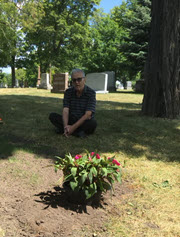 When
I went to purchase our graves, after she was told she had less than a year
to live and entered palliative care, I wanted her to have a nice spot
beneath a large tree. To get my desired location I had to purchase the three
graves in the vicinity. When I told her, she said I was wasting my money.
She had no further objections when I explained that I would visit her on the
hottest of days and sit in the shade of that tree and we would talk. To the
left is a picture of me sitting in the shade a few days after Lucette's
burial having planted the first of many flowers and shrubs before the
installation of our tombstone.
When
I went to purchase our graves, after she was told she had less than a year
to live and entered palliative care, I wanted her to have a nice spot
beneath a large tree. To get my desired location I had to purchase the three
graves in the vicinity. When I told her, she said I was wasting my money.
She had no further objections when I explained that I would visit her on the
hottest of days and sit in the shade of that tree and we would talk. To the
left is a picture of me sitting in the shade a few days after Lucette's
burial having planted the first of many flowers and shrubs before the
installation of our tombstone.
The people from Beechwood placed her body in what is commonly referred to as a body bag, which they then carefully lowered onto a gurney. They asked if I wanted to accompany them to where a hearse waited to take her away. For the first time, I experienced the pain that the man who rocked the coffin must have felt, and they left without me.
I had been playing with the man’s son in a sandbox one afternoon. It was not a real sandbox, just a pile of sand dumped in the middle of a muddy driveway. The boy's father, who was in the gravel hauling business, came home at the end of the day unaware that his son was still playing on the pile of sand and drove over him.
My older sister Rosa took me to my friend's house to see him the evening before the funeral. I was standing in front of the open coffin in the living room admiring how good he looked in his tidy little suit and tie, his black hair combed back all slick and shiny, when the tiny coffin started rocking back and forth and a voice started to shout.
I looked up and noticed his father, his hands resting on the open end of the coffin, jerking it back and forth and yelling, « Réveilles toé! T’es pas mort; réveilles toé! (Wake up! You're not dead; wake up!) » over and over.
The man was crying, with big tears running down his face. It was the first time I had seen a grown man cry. I promised myself that I would never do that when I got older. It's a promise I obviously could not keep. Like the man who rocked the coffin I can, and still do, get all emotional in public; an unexpected kindness can bring on the outset of tears, and there is nothing I can do about it, so there!
Lucette Carpentier, B.A., M.A., M.B.A., passed away on Friday, July 5, 2019 at 2 o’clock in the afternoon.
She loved, lived and died on her terms. Again, there was so much left unsaid. We talked around her impending suicide, not about it. How I wish I had asked the question posed to her by the man who fulfilled her wish to die on her terms when there was time for an explanation.
Lucette was the woman whose insights I valued the most, and yet, about the most important event in anyone’s life that is one’s death, I could not bring myself to ask her to tell me about how she felt and what her passing meant, not wanting to cause her unnecessary distress. Toss another regret on the regret pile.