Boreal Books |
The Koran
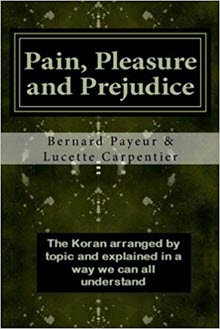
Pain, Pleasure and Prejudice The Koran by topic, explained in a way we can all understand Paperback: 828 pages. Comprehensive Index. If what you are looking for is a quick and complete reference to what Allah revealed to Muhammad in His Koran, or a coffee table type of book that is bound to spark a spirited discussion about a timely topic, then look no further than Pain, Pleasure and Prejudice. -------- I’ve just finished reading Pain, Pleasure and Prejudice by the Canadian scholar (sic) Bernard Payeur [and Lucette Carpentier], and the book is exactly what it’s touted to be: “everything you’ve always known about the Koran, and more, explained in a way we can all understand”. Mr. Payeur’s original field is not Islamic studies, so he approaches his task as an intelligent outsider. The result is a thorough and comprehensive view of what the Koran actually says. In addition to the Koran itself, the author has read the hadiths and various commentaries by Muslim theologians, so the book reflects the established Islamic institutional understanding of what Islam’s holy book means. Virginia U.S.A. Perhaps the most interesting part of the book for me was putting it in a historical context when describing the life of Mohammed and how this could have affected the writing of the Koran. London, U.K. Brings order to chaos. Ottawa, Canada
Pain, Pleasure and Prejudice may be too cumbersome or expensive for some, even as a paperback, which is why it has been broken up into six smaller books, all priced under $18.00. |

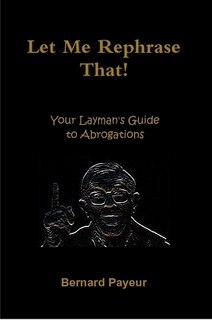
Let Me Rephrase That! Your Layman's Guide to Abrogations Paperback, 204 pages. 16:101 And if We replace a verse by another – and Allah knows best what He reveals – they say: “You [Muhammad] are only a forger.” Surely, most of them do not know. Knowing what more than 200 revealed truths (immutable facts communicated to a mortal by a god) an assumed omniscient deity replaced or abolished i.e. abrogated, as inconceivable as that may seem, is essential to understanding the ultimate Message of the Koran. Cover art is a rendition of a picture of George Burns from a poster for the 1977 Warner Bros. film "Oh, God!". Like the movie, I hope you will consider Let Me Rephrase That! a mildly irreverent but never gratuitous treatment of a reverential figure.
|

Kids and The Koran
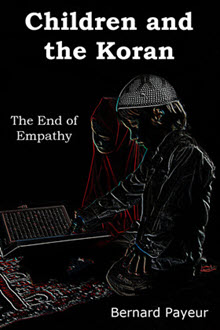
Children and The Koran The End of Empathy Paperback, 186 pages A lack of empathy, whether it be an instilled pathology or a manifestation of loyalty to one’s tribe which successive governments and our courts have encouraged by favoring religious distinctiveness over shared secular values, means we can no longer count that love of country or respect for Western civilization and what it stands for will see us through. The threat that an absence of empathy and tribalism poses can be significantly reduced if we diminish the hate-that-binds; if we stop a god’s pathological loathing for those who believe he is a figment of a man’s imagination from corrupting innocence by making the Koran for adults only. By having you read what children who should be enjoying Babar the Elephant or Cinderella are reading, I hope to convince you to try to do just that—for their sake, and ours.
|
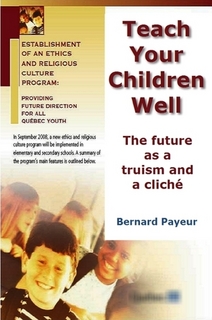
Teach Your Children Well The future as a truism and a cliché Paperback, 87 pages It is both a truism and a cliché that children are the future. Where that future will be shaped is in the classroom. Teach Your Children Well looks at the long term implications of reintroducing the teaching of religion in the public school system, and the granting of exceptions to the general curriculum for religious reason In Canada, with the Province of Québec leading the way, a secular public school education is being sacrificed to accommodate a religion which considers schooling where its revealed scriptures are not given precedence as blasphemous. Can two incompatible value systems be accommodated within the public school system and the inevitable clash between reason and unreason avoided? Will the politics of accommodation lead to peaceful co-existence, or simply allow Islam to recruit in a place that was previously off limits?
|

The Prophet
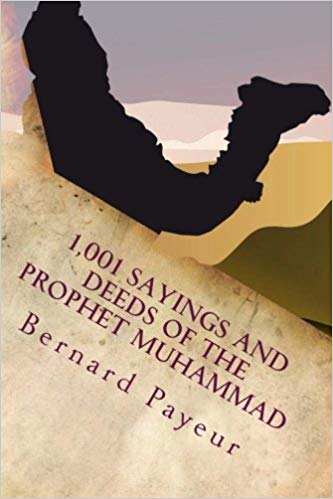
1,001 Sayings and Deeds of the Prophet Muhammad Paperback, 440 pages. Islam is not so much a religion as a way of life with thousands of indelible rules which instruct every waking moment of a believer’s existence. First, there are God's revealed rules, those of the Koran which we have talked about in Pain, Pleasure and Prejudice; and then there are the hadiths (or Hadith, in English academic usage hadith is often both singular and plural), the sayings and example i.e. deeds of the Prophet Muhammad. For fundamentalists, the Koran and the hadiths define what is Islamic law and is all you need to know about the nature of your existence and how to lead a God-fearing life. In learning about the hadiths, you will also get acquainted with the real Muhammad as his closest friends and his child-bride Aisha remember him.
|
Plays/Scripts
Remembering Uzza If Islam was explained to me in a pub Paperback, 452 pages. Remembering Uzza is meant to make learning about Islam a mostly pleasant experience while not sugar-coating or leaving out the nasty bits. And, is there a better place to get acquainted with a religion that has everyone talking then in the relaxed atmosphere of a favourite pub in the company of friends and a troubled but engaging young woman to give you an insider's perspective The name Uzza is from al-Uzza ("al" before the name means "the"), the Arab Venus and the most revered of all their goddesses. Pre-Islamic Arabs worshipped al-Uzza, along with al-Lat and Manat who they believed to be the daughters of Allah. Uzza is a story for our time that has the potential to change the course of things to come. Except for Uzza, and a short appearance by a couple from a neighbouring municipality, all other characters, including Archie the bartender, are modeled on real patrons of a once popular Ottawa nightspot. To keep the conversation between Uzza, Johnny, Gerry, Bob and Archie as unaffected as possible, implicit and explicit references to verses of the Koran and the sayings and actions of the Prophet are explained in a substantial supplement of endnotes. September 1, 2019 |
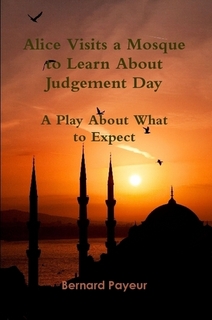
Alice Visits a Mosque to Learn About Judgment Day Paperback: 80 pages The dialogue is made up, but the revelations are real, as are the sayings of the Prophet Muhammad. The character of Alice only bears a remote resemblance to the heroine of Lewis Carroll's tale of a young girl "who falls down a rabbit hole into a fantasy world populated by peculiar, anthropomorphic creatures." Alice visits a Mosque to learn about Judgement Day is a short, often brutal play/script (it could not be otherwise) about an important concept in Islam on which the Koran expounds at length. Alice is not meant to offend but to enlighten. It is both a play and an invitation to learn more about the Koran and the Prophet. We hope you will read it (or see it if it ever makes it to the stage or the screen) in the spirit it was written.
|
Canada - The Fractured Nation Interviews An Inquiry Into The Breakup Paperback, 228 pages 2006 nominee for The Sunburst Award for Canadian Literature of the Fantastic. Imagine a world where Canada is just a memory. Imagine that the breakup of Canada has been a reality for almost ten years. How did Canada’s demise come about? What has happened since Canada disappeared from history, and what do former Canadians have to say about the country that is no more.
|
Essays
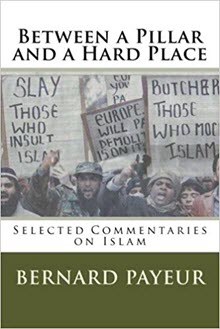
Between a Pillar and a Hard Place Paperback, 274 pages "We in the West find it incomprehensible that theological ideas still inflame the minds of men, stirring up messianic passions that can leave societies in ruin. We had assumed that this was no longer possible, that human beings had learned to separate religious questions from political ones, that political theology died in 16th-century Europe. We were wrong. "After centuries of strife, the West has learned to separate religion and politics – to establish the legitimacy of its leaders without referring to divine command. There is little reason to expect the rest of the world – the Islamic world in particular – will follow." Mark Lilla, professor of the humanities at Columbia University in The Stillborn God: Religion, Politics and the Modern West (2007) If you are going to read one book on Islam, make it Between a Pillar and a Hard Place. In mostly short, easy-to-read, to-the-point essays, I touch upon everything you need to know about the implications of being wrong.
|
BOREAL 2016 Paperback, 432 pages A commemorative recreation on paper of comments, articles and extracts of a watershed year when headlines and scriptures came together like at no other time since boreal.ca went live in April of 2003.
|
A Personal Journey
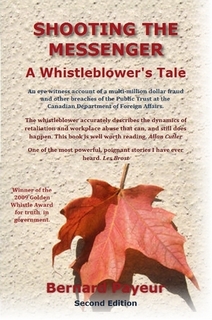
Shooting the Messenger A Whistleblower's Tale A statement about politics, morality and ethics in government with the Canadian Foreign Service as the erstwhile villain. Paperback, 187 pages One of my first memories is of a man crying. I had played with the crying man's son in a sandbox that afternoon. It was not a real sand box, just a pile of sand dumped in the middle of a muddy driveway. The boy's father, who was in the gravel hauling business, came home at the end of the day, unaware that his son was still playing on the pile of sand, and drove over him. I was standing in front of the open coffin admiring how good he looked in his tidy little suit and tie, his black hair combed back all slick and shiny, when the tiny box started rocking back and forth and a voice started to shout. I looked up and noticed a man with his hands resting on the open end of the coffin, jerking it back and forth and yelling “wake up, you're not dead, wake up!” (Réveilles toé, t’es pas mort, réveilles toé) over and over again. The man was crying, with big tears running down his face. It was the first time I had seen a grown man cry. I promised myself I would never do that when I got older. I did not cry when, maybe seven years later, I suffered a similar fate to my childhood friend — crushed under a giant wheel. This near death experience would serve to remind me, later in life that we are not here just to occupy space; that we are here for a reason and not just “to live well”, to quote George Herbert [1593-1633]. It's not that I don't get all emotional; an unexpected kindness can bring on the outset of tears, but disappointments only a brief sadness that rarely lasts very long. I am easily disappointed, not easily discouraged as the books that came after can attest.
|

Boreal Books® is a registered trademark of Bernard Payeur